
Stop Preparing Your Kids for Jobs
The economy is changing faster than parenting.

The advice every parent got for twenty years just expired.
“Make sure they learn to code.” “Get them into STEM.” “A computer science degree is the safe bet.” Responsible, practical guidance — optimized for an economy where human execution was the bottleneck.
AI eliminated that bottleneck almost overnight. Not in a decade. Not gradually enough for the advice to update itself. Overnight.
I have young boys. The oldest is eight. By the time he’s applying to college — if college still makes sense, which is its own question — the career landscape will be unrecognizable. Not just different. Unrecognizable. And the advice I was raised on, the advice most parents are still giving, was calibrated for a world that’s already gone.
Robots taking jobs is obvious and that framing feels quaint. What I’m worried about is what happens to your kids when the entire premise of career preparation stops working — and what to do about it before the thing in their pocket does the deciding for them.
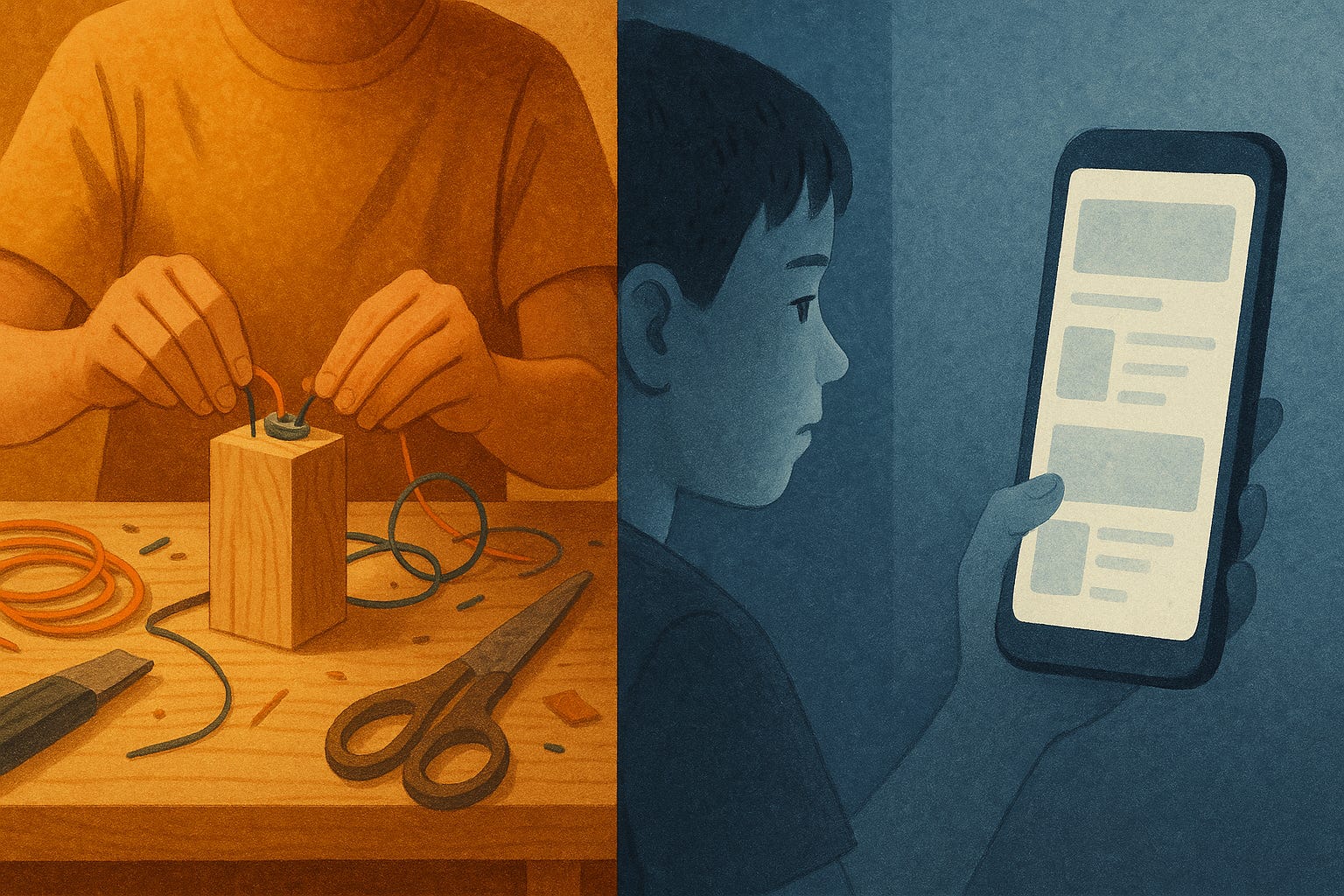
The Old Playbook Is Dead
Junior lawyers are being displaced. Entry-level analysts. Accountants. The starter roles in every “safe” career parents spent two decades pushing kids toward — first to go.
Nobody expected that. Every previous automation wave hit blue-collar workers first. Factories, farms, assembly lines. The professional class got to design policy responses from a comfortable distance — retraining programs for factory workers, think pieces about the dignity of labor, all written from a desk that felt permanent.
This time it started in the office. The disruption landed in the professional class’s living room. That creates a political dynamic we’ve never seen: the people who traditionally design policy responses to economic disruption are the ones being disrupted. Whether that produces better, more empathetic policy or sheer panic from a class with enormous political leverage — we’re about to find out.
The parents who steered their kids away from trades and toward knowledge work may have pointed them directly into AI’s crosshairs.
Meanwhile, the kid who wanted to be a carpenter has a physical-world moat. At least for now. (Robots will eventually handle most trades too, but that’s still years out. The physical world buys time that the digital world doesn’t.)
The “risky” path — follow your interests, go deep on something you actually care about, build things with your hands — turned out to be the strategic one. The parents who said “that’s not practical” were wrong — what’s practical changed under their feet.
The Bigger Picture (and Why It Matters for Your Kid)
Here’s the uncomfortable part of economic growth: every massive economic expansion in human history was built on coerced labor. Rome. Colonial economies. The antebellum South. The Industrial Revolution. Even globalization — cheaper production always meant finding someone more desperate to do the work.
AI breaks that pattern. For the first time, we have labor that scales massively, costs almost nothing, doesn’t tire, and doesn’t suffer. You don’t have to exploit anyone to get it. That’s genuinely new.
But the economic value flowing from AI doesn’t automatically distribute itself. Slavery’s gains didn’t flow to everyone — they flowed to plantation owners. The structural risk with AI is identical on the capital side. If AI productivity flows only to those who own the models and infrastructure, we’ve removed the suffering but recreated the concentration.
So where does that leave your kid?
It depends on which future materializes. In the darkest version — and honestly, the most likely by default — you get a small ownership class, a modest professional class serving them, and a vast population that’s economically superfluous and purposeless (though not necessarily poor). We already have a preview in communities where industry left: deaths of despair, addiction, radicalization. Scale that to the majority of the population and it’s terrifying.
The optimistic version requires something harder than technology: a cultural shift where identity decouples from economic production. Where people build, create, connect, and pursue mastery not for money but for meaning. It requires kids who have an internal engine that doesn’t need a paycheck to run.
The most likely version is a messy hybrid. Some people thriving. Some people drowning. And the difference between the two groups won’t be intelligence or education or even luck. It’ll be whether they developed purpose before the economy stopped demanding it.
This is especially hard because the economic incentives of the largest companies on Earth are aligned against your kid developing that purpose. Every hour they scroll TikTok instead of creating something, someone makes money. Complacency is the business model.
So that’s what this is really about: raising humans who can function — who can thrive — in a world that no longer requires them to work, while an industry spends billions keeping them passive. The most important things you can give them aren’t skills. They’re qualities. Curiosity. Depth. The ability to sit with something difficult long enough to get good at it. An identity that doesn’t depend on a job title.
What Actually Compounds
Here’s what I’ve noticed about the people thriving right now: none of them learned their skills as a career strategy.
They’re the ones with genuine curiosity that compounded over decades. There’s a massive difference between a CS degree pursued for job security and thirty years of building things because you couldn’t stop yourself. AI amplifies people with real taste, vision, and intrinsic drive. It exposes everyone who was going through the motions. If you’re doing your job because it pays the bills, not because it’s the thing you can’t stop thinking about — the gap between you and someone who actually cares is about to become very visible.
You can’t fake compounding interest. A kid who’s been obsessively tinkering with electronics since age eight has something a bootcamp graduate doesn’t — not knowledge, but relationship with the work. Depth that can’t be shortcut. The kind of understanding that lets you look at a problem and know, before you can articulate why, that something is off. That’s taste. And taste is the one thing AI can’t generate for you.
The person who learned Python because a career counselor said to will use AI as a faster way to do the same tasks. The person who learned Python because they were trying to automate their weird hobby will use AI to do things nobody else has thought of. Same tool, completely different outcomes.
The lesson for parents: your kid’s obsessions aren’t distractions from their future. They are the future. The ten-year-old who won’t stop drawing isn’t wasting time. The twelve-year-old who’s deep into mushroom identification isn’t being impractical. They’re compounding.
And this isn’t just about tech kids. The same applies to the kid who wants to build teepees in the forest, or practice 87 different ways to prepare eggs, or spend every weekend building Lego creations nobody asked for. The domain doesn’t matter. The depth does.
The Provenance Generation
When AI makes production infinitely cheap, the scarce resource becomes authentic human intention.
Think about it. If anyone can generate a novel, a song, a design, a business plan in thirty seconds — what’s left? When production cost approaches zero, production itself has no value. What’s left is the same thing that makes a handmade chair worth more than an IKEA flat-pack: provenance. The who and the why behind it. The fact that someone chose to make this, in this way, for this reason.
“Why should I care that you made this?” becomes the defining economic question.
Craft, taste, story, a genuine point of view — these are the things no model can commoditize. Kids who develop a distinctive voice and a deep relationship with a craft own something permanent. This is true whether the craft is woodworking, cooking, music, writing, or building software with real intentionality.
There will be more roles for craftsmen in the AI economy, not fewer. But they’ll be valued for what machines can’t replicate: the fact that a human gave a damn.
The same applies to teachers, coaches, counselors — anyone whose presence is the point. I think we’ll see a boom in hands-on experiences: week-long photography workshops, writer’s retreats, wilderness expeditions. When everything can be delivered digitally, showing up in person becomes the luxury.
I’m making an economic argument here, not a nostalgic one. When everything can be produced, nothing produced has inherent value. Value migrates to intention, to story, to the irreplaceable specificity of a person who cared enough to make a choice. The kid who develops that — who has a point of view and the craft to express it — is holding the one currency that doesn’t inflate.
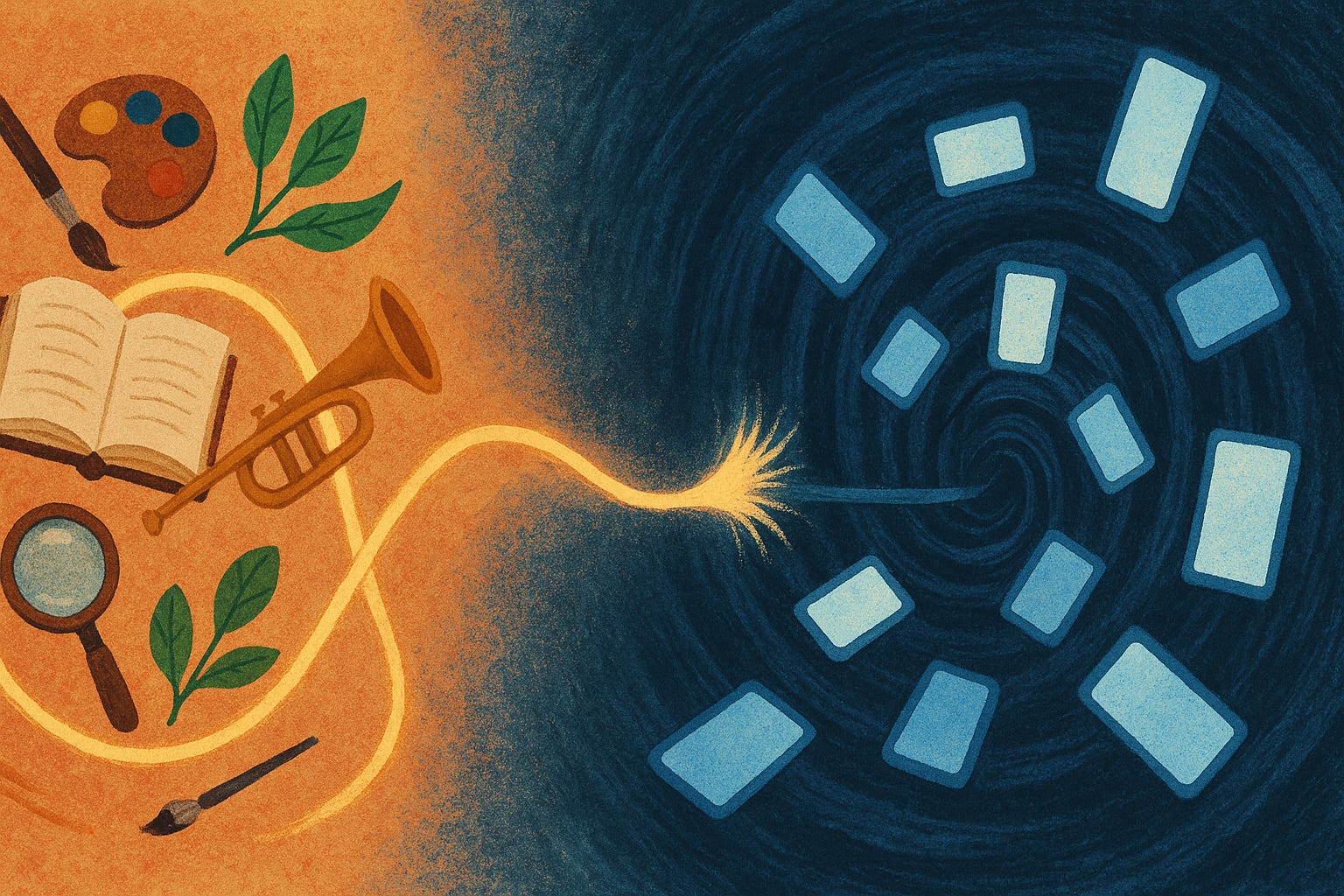
The Attention War
The qualities kids need most — curiosity, depth, intrinsic motivation, sustained focus — are exactly what algorithmic feeds are engineered to destroy.
This isn’t accidental. Social media and algorithmic content are systems purpose-built to capture attention and convert exploration into passive consumption. A kid who spends hours going deep on something weird and personal is developing the exact muscle this economy rewards. The algorithm’s job is to interrupt that process and replace it with frictionless dopamine.
The feed doesn’t want your kid to be curious. It wants your kid to be engaged. And those are opposite things.
Curiosity pulls you outward into the unknown. Engagement traps you in a loop of what already works on you.
Complacency is the product. A complacent user scrolls longer, clicks more ads, and never leaves the platform. From an engagement perspective, complacency is the ideal outcome. But a complacent human in the AI economy has nothing to offer — no taste, no drive, no point of view worth paying for.
This is an economic argument, not a screen time one.
I know how that sounds. Parents have been wringing their hands about screens for a decade, and kids are fine, and every generation panics about new media, and maybe we should all relax.
No. This is different. The timing is catastrophic. We are entering an economy that rewards exactly one thing — intrinsic motivation — at the exact moment an industry has perfected the art of destroying it. Every hour a kid spends in an algorithmic feed is an hour they’re being trained out of the self-direction that will define success in the next economy. That’s not a parenting opinion. It’s a market reality.
Purpose as a Survival Skill
The biggest risk for the next generation is purposelessness.
We already see the preview. A generation that can scroll for six hours but can’t sit with boredom for six minutes.
The algorithmic feed and the post-labor economy are a catastrophic combination. One eliminates the need for human effort. The other eliminates the desire for it.
When survival is decoupled from labor, the kids who have an internal engine — mastery, curiosity, service, connection — will thrive. The kids waiting for external structures to tell them what to feel, watch, and care about will struggle profoundly.
Purpose isn’t something you discover after you’re financially secure. It’s something you cultivate from childhood — unless something strip-mines it first. Or interrupts you from ever developing it. A kid who spends all day watching PAW Patrol or YouTube never has time to be bored, which means they never have time to discover what they actually care about. Boredom is where passion comes from.
We’ve spent a generation telling kids that meaning comes after stability. Get the degree, get the job, get the house — then you can figure out what you care about. That sequence never really worked, but at least the structure kept people moving. Remove the structure — remove the economic necessity that forced people out of bed — and you’re left with people who never learned to move on their own.
This is already happening. Look at the statistics on young men not in education, employment, or training. Look at the rates of anxiety and depression in teenagers. Look at the kids who graduate from good colleges with good grades and genuinely have no idea what they want. My LinkedIn feed is full of incredible engineers I’ve worked with over the years who’ve been laid off in the last twelve months. These aren’t personal failures. They’re systemic ones. We optimized kids for compliance and credentialing and forgot to help them develop an inner compass.
What This Looks Like at Home
Let them build. My kids build things. Not because I’m training future engineers — because the act of making something develops agency and taste in ways that nothing else does. A Lego set with or without instructions. A birdhouse that falls apart. A terrible song recorded on a phone. A movie of their own design. A strange configuration of shapes in free-form. It doesn’t matter what they build. What matters is that they experience themselves as someone who makes things rather than someone things happen to. Building is the antidote to consuming.
Protect their attention with intention, not fear. I’m not anti-technology. I build with AI every day — I have a team of AI agents working around the clock on projects for me. Make sure they experience tech as a tool they direct, not a feed that directs them. There’s a world of difference between a kid who uses a computer to make something and a kid who opens TikTok because they’re bored.
And now, nearly anything they can imagine, they can create. A kid with a vision and basic prompting skills can build apps, compose music, make films, design products. Access stopped being the barrier. Having something worth building became the barrier.
Stop optimizing for credentials. A kid who goes deep on something “impractical” is developing exactly the muscles this economy rewards. The fourteen-year-old who’s obsessed with fermentation isn’t wasting time. The eight-year-old who wants to know everything about bridges isn’t being weird. They’re going deep. That’s the skill. Let them. Encourage them. Don’t stifle it in favor of skills that made sense when we were growing up.
Teach them to direct AI, not compete with it. The skill is knowing what’s worth building and why. A kid who understands what matters — who has taste, judgment, a point of view — can direct AI tools to build things that actually mean something. A kid who only knows how to execute instructions is competing with a machine that executes instructions infinitely faster.
Model it. Kids don’t learn purpose from lectures. They learn it from watching you engage with the world intentionally. They notice what you reach for when you’re bored. They notice whether you build things or scroll. They notice if your phone comes out at dinner. Model the life you want them to live.
Resist the anxiety. The instinct to push kids toward “safe” paths is strong, especially now. But safety has moved. The conventional path — credentials, prestigious firms, climbing a ladder — is now the risky one. The kid following genuine curiosity down an unmarked trail is the one with the advantage. That’s terrifying for parents. Sit with it.
Talk about this stuff. Not in a doom-and-gloom way, but honestly. Kids are perceptive. They hear the anxiety in adult conversations about AI. They see the headlines. Give them a framework that’s empowering, not paralyzing: the world is changing fast, the people who thrive will be the ones who build and create and go deep, and that’s exactly what you’re already doing when you spend three hours on that weird project in the garage. Name it. Make it legible to them.
The Paradox
The most practical thing you can do for your kid’s economic future is to stop thinking about their economic future.
The economy is shifting to reward exactly what good parenting has always tried to cultivate — curious, self-directed, purposeful humans. But we’ve allowed an industry to plant itself between our kids and those qualities, strip-mining their attention for ad revenue.
For the first time in modern history, “follow what drives you” isn’t idealistic advice. It’s the most strategic thing a parent can say. The practical path and the passionate path have converged. The Venn diagram is a circle.
But only if your kid still has the capacity to be driven by something real. And that’s the part that scares me — because there’s a multi-trillion-dollar industry working around the clock to make sure they don’t.
AI gives us something unprecedented — an economy where human labor is increasingly optional. That should be liberating. The question “what do you want to be when you grow up?” finally gets to mean “what kind of person will you become?” instead of “what job will you do?”
But liberation requires capacity. A freed prisoner who’s never made a decision doesn’t know what to do with freedom. A kid whose curiosity was strip-mined by algorithms and whose ambition was channeled into credentials doesn’t know what to do with an open future.
That question — “what kind of person will you become?” — is only liberating if a kid has the inner life to answer it.
Raising kids who can answer that question. Protecting their curiosity. Guarding their depth. Letting them go deep on things that don’t make sense to you yet. Resisting the urge to optimize them for a world that no longer exists.
This isn’t about homeschooling or Waldorf or going off-grid. It’s about making a series of small, daily choices. Do you let the algorithm babysit, or do you sit with the boredom until something real emerges? Do you push them toward the “responsible” extracurricular, or let them spend Saturday afternoon taking apart a broken toaster? Do you ask “will this look good on an application?” or “does this kid come alive when they do it?”
The answers seem obvious when you write them down. They’re harder at 5 PM when you’re exhausted and the iPad would buy you an hour of quiet. I know. I’m there too.
But the stakes have changed. The margin for error on attention and purpose has narrowed dramatically. Not because the world is ending — because the world is opening up in ways that reward depth and punish drift. Your kid’s relationship with their own curiosity isn’t a nice-to-have anymore. It’s the whole game.
The irony is almost too clean: the most strategic parenting advice in the age of AI is the advice idealists have been giving forever. Follow what drives you. Build things. Pay attention. Go deep.
It just happens to finally be true.
Thanks for this article! I'm a dad, and I'm constantly searching for ways to be a better dad. There are some keen insights here that inspire me.
As an artist, I, of course, have a few issues with AI's illustrations.
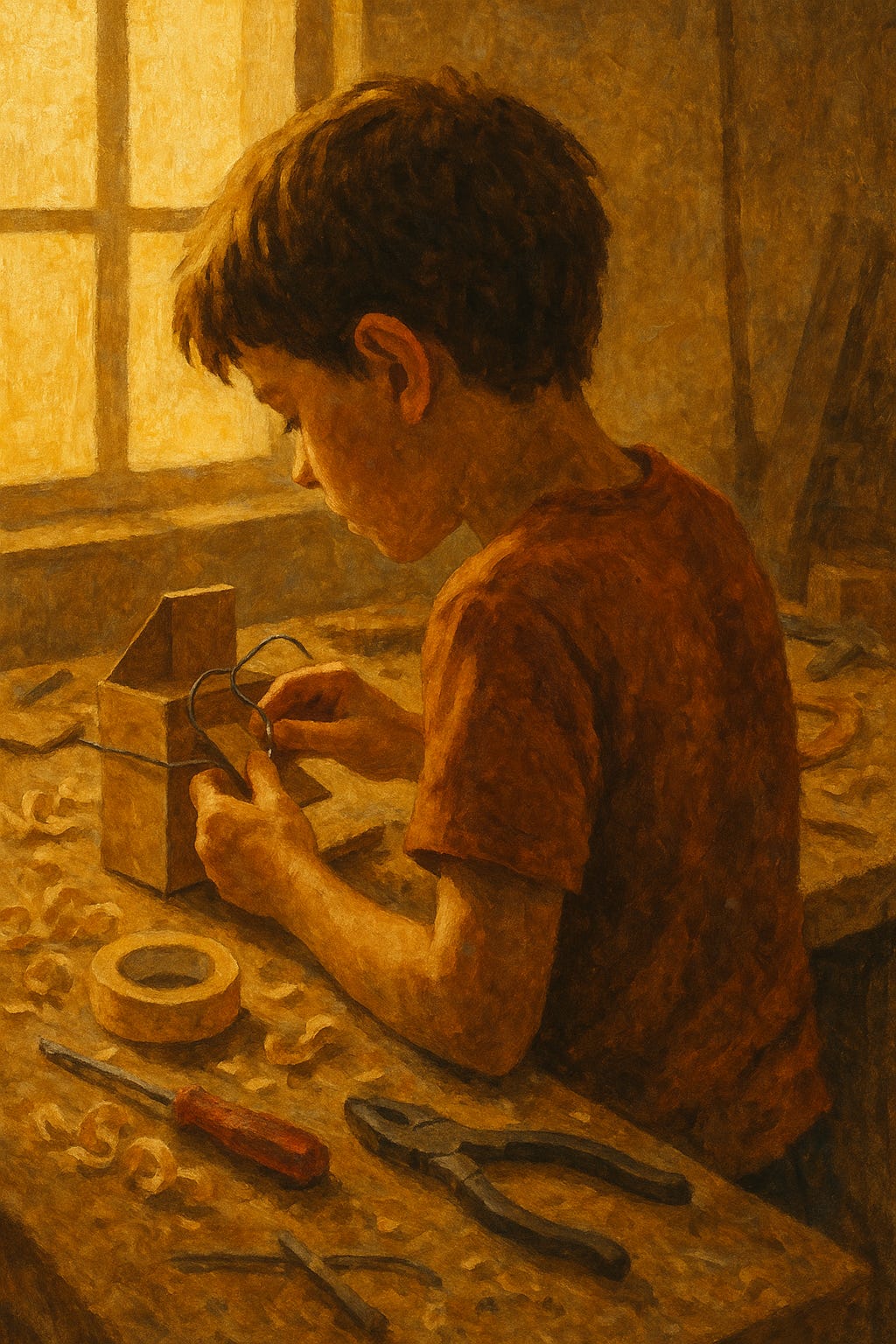
I understand the extra large phone in the child's hand. It suggests our phones can be powerful and domineering. But why is the child's hand also extra large? The point would be stronger if the child had a normal sized hand.
There are a lot of wood shavings on the child's workbench. But there is no tool visible that would create such shavings. A human artist would be more careful with details like that.