
He Has Risen: The Return of Piracy
How Streaming's Enshittification Revived What It Killed

Last week I put out a call asking whether anyone had returned to piracy after years away. The responses came faster than I expected—and from people I wouldn’t have guessed. Software engineers. Parents in their 40s. People with disposable income who had happily paid for streaming services for a decade.
The story was remarkably consistent: I used to have Netflix and that was it. Now I need five or six services just to watch what I want. I’m paying more than cable ever cost. And somehow the experience is worse.
One friend put it bluntly: “I stopped pirating because streaming was better. I started again because streaming became worse than cable.”
The Enshittification Cycle Comes for Streaming
What my friends are describing has a name. Writer Cory Doctorow calls it enshittification—a term so precisely descriptive it was named the American Dialect Society’s Word of the Year in 2023.
Doctorow’s framework describes a predictable three-stage arc that big tech follows: First, platforms are good to users to attract them. Then they abuse users to make things better for business customers (advertisers, studios). Finally, they abuse those business customers to extract maximum profit for shareholders. Then they die—or become something unrecognizable.
“Here is how platforms die: first, they are good to their users; then they abuse their users to make things better for their business customers; finally, they abuse those business customers to claw back all the value for themselves.”
Sound familiar? Netflix launched in 2007 at $7.99/month for unlimited streaming. No ads. One simple plan. By January 2025, that same ad-free experience costs $17.99—with premium reaching $24.99. Where Netflix took about fourteen years to double its original price, Disney+ accomplished the same feat in just four.
The average American household now subscribes to four streaming services at a combined cost of $69 per month—a 13% increase from last year alone, according to Deloitte’s 2025 Digital Media Trends report. Many households report spending over $100 monthly across six or more services.
We cut the cord to escape cable. We’ve rebuilt cable, but fragmented and more expensive.
The UX Degradation Nobody Asked For
But it’s not just the money. The experience itself has degraded in ways that feel almost deliberately hostile.
Amazon Prime Video—once praised for its clean, ad-free interface—inserted ads in January 2024 without reducing prices. Want the experience you previously paid for? That’ll be an extra $2.99/month. Reviewers have called it “insulting to sit through ads on a previously ad-free service.”
Netflix’s password-sharing crackdown in 2023 generated immediate backlash—Spain reportedly saw a million cancellations. Research from MoffettNathanson found that a majority of password sharers now view Netflix negatively, with nearly 80% of affected users under 35 expressing negative perceptions. Netflix pushed through anyway, banking on the reality that switching costs and content fragmentation would prevent mass exodus.
They were right. Netflix added 27% more subscribers in the eighteen months following the crackdown. The message to the industry was clear: you can make users angry if you’ve made leaving hard enough.
Meanwhile, the interfaces themselves optimize for engagement over usefulness. Autoplay trailers you can’t disable. Algorithmic recommendations designed to keep you browsing rather than watching. Content buried behind “because you watched” carousels that somehow never surface what you’re actually looking for, because they would rather get you started on a 7 hour “Real Housewives” binge.
Rising prices, growing ad fatigue, and uneven user experience are reshaping streaming behavior, creating tension between cost and experience as viewers reevaluate services and shift toward options that deliver clear value.
The Numbers Don’t Lie
Global piracy site visits ballooned from roughly 104 billion in 2020 to over 216 billion in 2024—a 66% increase in four years, with film and TV leading the surge. MUSO’s 2024 report tracked 216.3 billion visits to piracy sites globally.
The demographics tell the real story. Studies show 67-76% of Gen Z and millennials admit to using illegal platforms alongside paid subscriptions. Not instead of—alongside. They’re paying for multiple services AND pirating, because the legitimate options have become so fragmented and frustrating that piracy fills the gaps.
In Sweden, 25% of people aged 15-24 openly admit to pirating content, viewing streaming as “cable 2.0.” European households now spend around €700 annually on subscriptions. Indian families report spending $36/month for multiple streaming apps when cable cost $9.
The original promise of streaming was simple: pay a reasonable price, get access to everything, no ads, watch what you want when you want it. Every element of that promise has been systematically broken.
Why This Matters Beyond Entertainment
The return of piracy isn’t really about piracy. It’s a signal—a market correction that reveals what happens when the enshittification cycle runs its course.
Doctorow argues that four forces historically prevented this kind of rent-seeking: competition, regulation, labor power, and switching costs. Streaming services have systematically neutralized all four. Exclusive content deals eliminate competition. Regulatory capture prevents intervention. Tech workers never unionized. And content fragmentation across platforms creates artificial switching costs—cancel Netflix and you lose Stranger Things; cancel HBO and you lose House of the Dragon.
The only remaining check is what economists call “exit”—users leaving entirely. Piracy is exit. It’s consumers voting with their bandwidth that the legitimate product no longer delivers sufficient value for its cost and friction.
When a significant portion of paying customers simultaneously returns to illegal alternatives, the product has structurallyfailed. It no longer serves its users.
The Lesson for Technology Design
There’s a reason this matters beyond your Netflix bill. The same enshittification pattern plays out across every platform built on the post-2007 model of “free” services monetized through attention and data extraction.
Social media platforms that once showed you posts from friends now show you algorithmic content optimized for engagement. Search engines that once returned the best results now return results optimized for advertising revenue. Children’s apps that once taught skills now teach consumption patterns.
The streaming wars offer a compressed, visible version of what’s happened more slowly across our entire digital landscape. Users attracted with value, locked in with switching costs, then gradually squeezed until the original value proposition inverts entirely.
When I talk to parents about Cloudberry OS and why we’re building laptops designed around pre-2007 computing principles, this is the context. We’re not nostalgic for the past—we’re trying to build tools that structurally resist this cycle. Tools that remain tools, designed for the humans using them rather than for the shareholders extracting value from them.
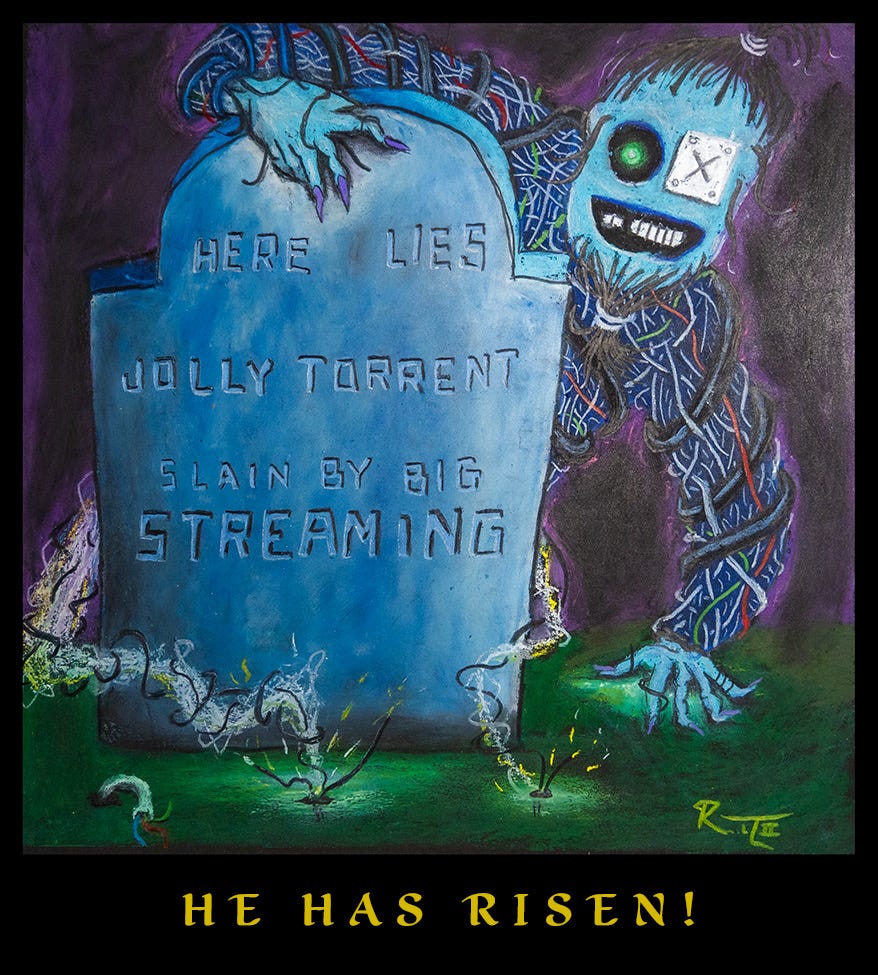
Until we build technology systems that can’t so easily turn against their users, Jolly Torrent will keep rising from his grave.
Sources: